Mother was Right

Like the author below’s mother, we love our night-time sip of Milk Of Magnesia, along with Epsom salts baths, as our supplimental Magnesium supply (or similarly effective, is a small pinch of Epsom salts in drinking water).

President’s Address: Mother was Right: The Health Benefits of Milk of Magnesia

Extract :

So what are the take home messages from this talk?

  • 1) Most patients are magnesium deficient (and most of us are someone’s patient).
  • 2) You know that patients are magnesium deficient if they have night cramps and should suspect that they are if they have Raynaud’s and no cryoglobulinemia.
  • 3) Those patients who require heroic doses of potassium replacement as well as those resistant to calcium channel blockers are probably magnesium deficient.
  • 4) Serum levels correlate poorly with tissue levels and are often misleading.
  • 5) Magnesium deficiency is often causative in multifocal atrial tachycardia and polymorphous ventricular tachycardia with a prolonged QTc interval.
  • 6) Magnesium deficiency may be causative in atrial fibrillation and may be the reason that achieving rate control in some patients with this arrhythmia is difficult.
  • 7) Magnesium replacement is often effective in decreasing extra systoles and occasionally in preventing/terminating reentrant arrhythmias.
  • 8) Magnesium supplementation may be effective in reducing the incidence/severity of osteoporosis, adult-onset diabetes, hypertension, and sudden death.
  • 9) Sometimes mother does know best.

Full : https://www.ncbi.nlm.nih.gov/pmc/articles/PMC1500911/

Infection and pH UTI

Urinary Tract Infection Natural Remedy: Low pH Levels In Urine And Certain Foods May Be To Blame For Frequent UTIs

Not every expert agrees cranberries, or cranberry juice, can help prevent urinary tract infections (UTIs): One study found people eating more cranberry products were 38 percent less likely to develop an infection, while a separate study found this benefit was small at best. However, the findings of a new study published in The Journal of Biological Chemistry may reconcile this difference of opinion.

UTIs typically occur when bacteria, such as E. coli, enter through the urinary tract and multiply in the bladder, the Mayo Clinic explained; though fungi and viruses can also cause a UTI. Once infected, the body will secrete a protein called siderocalin (SCN), which works as an antimicrobial to inhibit bacterial iron uptake. This uptake is how nearly all bacteria survive.

So to see how well SCN can influence an UTI, researchers sampled urine from volunteers previously participating in an immunological and pathogenic study conducted between 2008 and 2012. Among their results, they found urine better able to resist uptake had higher levels of pH (or more acid) and certain metabolites. Dr. Jeffrey P. Henderson, senior study author and assistant professor of medicine at Washington University School of Medicine in St. Louis, told Time the metabolites he and his team found were from dietary sources, not human cells.

“It looks like this protein that’s part of your immune system is able to use metabolites in the diet as grips to hold onto iron and keep it away from pathogenic bacteria,” Henderson said.

The high pH and metabolites together may be what promotes “restrictive urinary characteristics,” thus preventing or treating antibiotic-resistant E. coli UTI without compromising gut or vaginal microbes. More research would need to be done, but Henderson added the best part about his findings is the fact it proposes a non-antibiotic remedy.

Already now physicians recommend calcium-rich foods and supplements to boost urine pH. Think of citrus fruits, vegetables, and dairy products. But as Henderon points out to TIME, it’s harder to increase the levels of protective metabolites since there are individual differences to consider. Polyphenol-rich foods, however, are believed to source metabolities. These include tea, coffee, wine, and yep, cranberries.

Herein lies the possibility of reconciliation.

“One thing this suggests is that maybe the reason it’s not more effective is that people need both cranberries and a higher urine pH, or they need cranberries and appropriate inhabitants of their intestine, or the right microbiome composition in their gut, for the cranberry part to work properly,” Henderson concluded.

Source: Shields-Cutler, R.R., et al. Human Urinary Composition Controls Antibacterial Activity of Siderocalin. The Journal of Biological Chemistry. 2015.

ChooseLife : This is another signal that the terrain needs focus. We prefer Watermelon seed tea by Edgar Cayce (or just good Watermelon), along with alkalising techniques and taking any such issues as a sign dietary change is required. http://deepdownwellness.com/ddw/edgar-cayces-watermelon-seed-tea-for-kidney-stones/

Seaweed reduces Methane production in Holstein Cows

https://phys.org/news/2018-08-seaweed-dairy-cows-emissions.html

University of California researchers are feeding seaweed to dairy cows in an attempt to make cattle more climate-friendly.

UC Davis is studying whether adding small amounts of seaweed to  can help reduce their emissions of methane, a  that’s released when cattle burp, pass gas or make manure.

In a study this past spring, researchers found  were reduced by more than 30 percent in a dozen Holstein cows that ate the ocean algae, which was mixed into their feed and sweetened with molasses to disguise the .

“I was extremely surprised when I saw the results,” said Ermias Kebreab, the UC Davis animal scientist who led the study. “I wasn’t expecting it to be that dramatic with a small amount of seaweed.”

Kebreab says his team plans to conduct a six-month study of a seaweed-infused diet in beef cattle starting in October.

More studies will be needed to determine its safety and efficacy, and seaweed growers would have to ramp up production to make it an economical option for farmers.

Dairy farms and other livestock operations are major sources of methane, a heat-trapping gas many times more potent than carbon dioxide.

ChooseLife : Seaweed and Molasses, is there no end to the magnificence of this combination? https://sicknesshope.com/ Moreless knew.

Brain pH Linked to Alzheimers

pH imbalance in brain cells may contribute to Alzheimer’s disease

Study identifies potential drug targets to reverse problem found in tiny organelles in astrocytes

Date:
August 2, 2018
Source:
Johns Hopkins Medicine
Summary:
Scientists say they have found new evidence in lab-grown mouse brain cells, called astrocytes, that one root of Alzheimer’s disease may be a simple imbalance in acid-alkaline — or pH — chemistry inside endosomes, the nutrient and chemical cargo shuttles in cells.

Full Article = sciencedaily.com

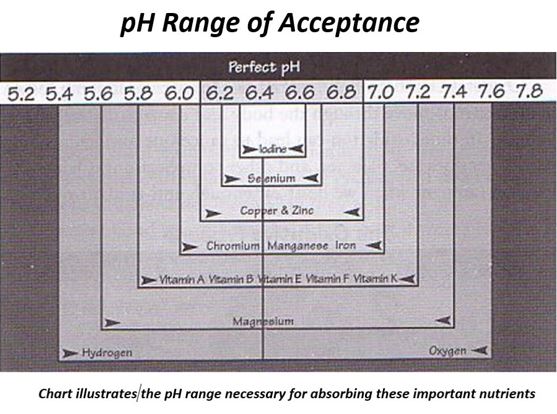
ChooseLife notes = Interestingly the pH of 6.21 was the average of those not affected, this is close to the tissue pH Carey Reams suggests we should be trying to be within (Below is a scheme showing the concept pH Range Of Acceptance):

Previously, I have seen some evidence, which Moreless cited, which showed that Fish demonstrate levels of Mercury tissue saturation, not chiefly based on the mercury levels of the water, but rather the pH. This strongly suggests that it is the pH which was the chief uptake driver of Mercury into tissue, not the levels of Mercury as you may assume (the studies showed a lake with lower pH and lower Mercury had Fish with higher levels of Mercury than another lake with higher pH and higher Mercury).

“Of interest, recent studies have shown that mercury levels in
water in a water-sediment partition system of high pH value were
higher than those in a comparable system of low pH (MATSUMURA et
al. 1972). Thus, we have the enigma of lower mercury content in
fish inhabiting waters of higher pH and comparably higher mercury
concentration. It appears that mercury concentration in water is
not the only factor controlling the amount of mercury in fish.” Full

This leads me to ponder, if similar is happening in our brains, with Aluminium starting to become more neuro-toxic as our pH drops? 

This similar principle, applied to dental Mercury, may explain why some do not suffer with amalgams, yet many feel they do? Perhaps those who suffer have generally lower saliva pH, which triggers the harmful effects, often believed to be from this element. 

(Alzheimers & Aluminium research = Link)